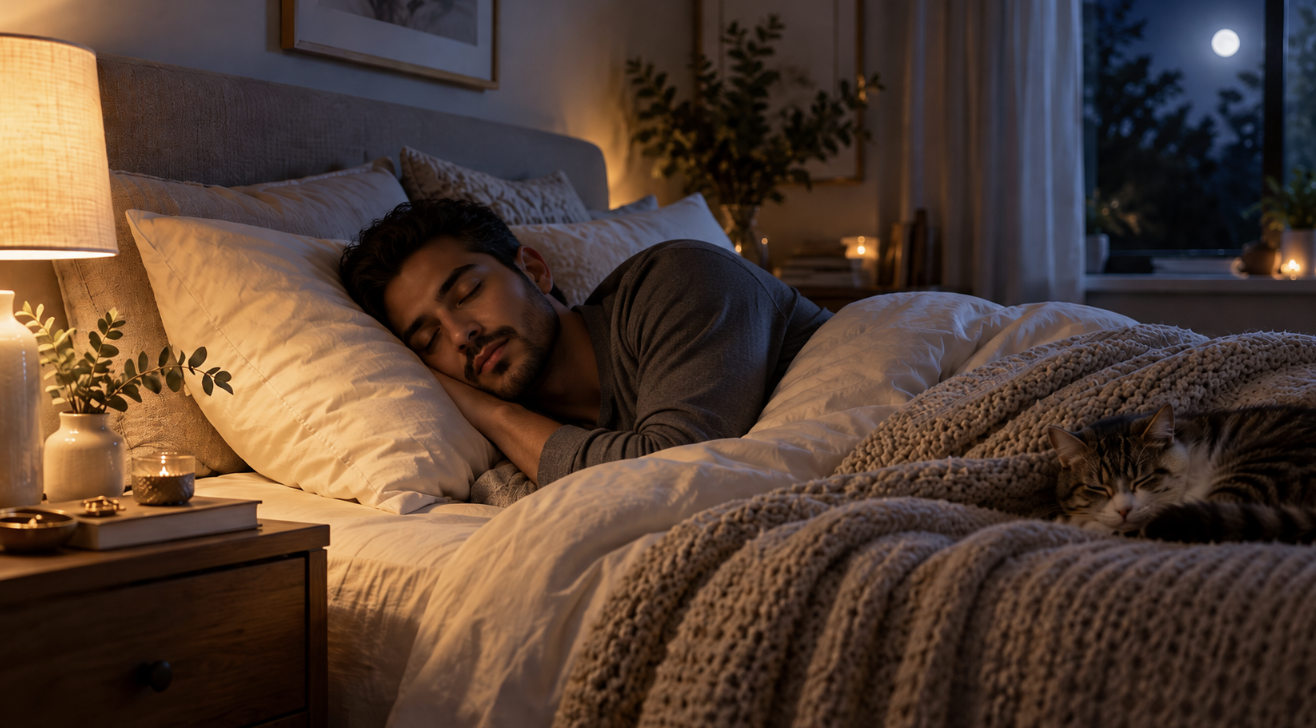
Sleep is usually the first thing people sacrifice when life gets busy.
You have an assignment to finish.
You want to watch one more episode.
You have to wake up early for work.
You start scrolling on your phone and somehow an hour disappears.
So you tell yourself:
“I'll just sleep more this weekend.”
But sleep isn't simply downtime.
While you're asleep, your brain and body are still incredibly active. Sleep supports brain function, physical recovery, metabolism, cardiovascular health, immune function, learning, attention, and emotional well-being.
The National Heart, Lung, and Blood Institute (NHLBI) describes sleep as essential for both physical health and healthy brain function.
In other words:
Sleep isn't wasted time. It's part of taking care of your health.
So... How Much Sleep Do You Actually Need?
For healthy adults, the American Academy of Sleep Medicine and Sleep Research Society recommend getting 7 or more hours of sleep per night on a regular basis to support optimal health.
Read the adult sleep-duration consensus recommendation
That doesn't mean exactly seven hours is perfect for every single person.
Some adults naturally need more.
Sleep needs can also change depending on factors such as age, illness, pregnancy, physical activity, accumulated sleep loss, and individual biology.
The important part is that routinely sleeping five or six hours because you've “trained yourself to function on less” is not the same thing as actually needing less sleep.
You might be able to get through the day.
That doesn't necessarily mean your body is getting all the sleep it needs.
What Actually Happens While You Sleep?
Sleep isn't one continuous state.
Throughout the night, your brain moves through non-REM and REM sleep in repeating cycles.
According to the NHLBI, most people move through roughly four to six sleep cycles per night, with each cycle lasting around 80–100 minutes.
Non-REM sleep includes several stages, ranging from lighter sleep to deep, slow-wave sleep.
REM sleep is the stage most strongly associated with vivid dreaming, although dreams can occur during other stages too.
Different stages appear to support different aspects of physical and brain function.
This is one reason sleep isn't just about whether your eyes were closed for eight hours.
Sleep quality and continuity matter too.
Your Brain Notices When You Don't Sleep Enough
You have probably experienced this one firsthand.
After a bad night of sleep, everything feels a little harder.
You reread the same paragraph three times.
You lose your train of thought.
You're more irritable.
Your reaction time feels slower.
And suddenly a task that normally takes 20 minutes takes an hour.
This isn't just in your head.
A 2024 systematic review and meta-analysis examined 44 studies in which participants were restricted to only two to six hours of sleep for one night.
Even after just one night of restricted sleep, participants experienced significantly greater sleepiness along with impairments in sustained attention, including slower reaction times and more attentional lapses.
Read the 2024 sleep-restriction meta-analysis
A larger meta-analysis of 61 studies also found that sleep restriction negatively affected several areas of cognitive performance, including executive functioning, sustained attention, and long-term memory.
Read the neurocognitive sleep-restriction meta-analysis
So when you're exhausted and feel like your brain isn't cooperating:
It probably isn't operating at its best.
Sleep and Learning Go Together
This is especially important for students.
Staying awake several extra hours to study can sometimes feel productive because you're technically spending more time with the material.
But learning also depends on your ability to:
pay attention,
encode new information,
remember what you learned,
and retrieve that information later.
Sleep supports those processes.
The NHLBI notes that insufficient sleep can interfere with learning, focusing, reacting, working, and decision-making.
So there comes a point when another exhausted hour staring at your notes may not be as useful as:
closing the laptop and going to sleep.
Sleep Is Connected to Your Heart
We usually think of heart health in terms of exercise, blood pressure, cholesterol, and diet.
Sleep belongs in that conversation too.
During normal sleep, your cardiovascular system goes through predictable changes. Heart rate and blood pressure generally decrease during non-REM sleep, allowing the cardiovascular system to operate differently than it does while you're awake.
Chronic sleep deficiency and disrupted sleep have been associated with an increased risk of cardiovascular conditions.
Learn how sleep affects the heart from the NHLBI
That doesn't mean one terrible night of sleep is going to cause heart disease.
Health outcomes usually develop from a combination of many factors over time.
The point is simply that:
sleep is part of cardiovascular health too.
Sleep and Metabolism Are Connected
Another area researchers have studied extensively is the relationship between sleep and metabolic health.
A large meta-analysis of prospective studies involving more than 480,000 participants found a U-shaped association between sleep duration and the development of type 2 diabetes.
The lowest risk was observed among people sleeping around 7–8 hours per day, while shorter and longer sleep durations were both associated with greater risk.
Read the sleep-duration and type 2 diabetes meta-analysis
More recent research looking at multiple aspects of sleep has found similar associations between short sleep, poor sleep quality, and type 2 diabetes risk.
Read the systematic review of sleep characteristics and diabetes
These are largely observational findings, so they don't mean that sleeping six hours automatically causes diabetes.
Many factors can influence both sleep and metabolic health.
But the research does reinforce an important idea:
sleep isn't separate from the rest of your physical health.
Your Immune System Likes Sleep Too
Sleep and the immune system have a surprisingly close relationship.
Research has shown that sleep and immune function influence each other in both directions.
Your immune system can affect how you sleep when you're sick, while insufficient or disrupted sleep can influence inflammatory and immune processes.
A major review published in Nature Reviews Immunology described extensive communication between sleep, the nervous system, and the immune system and explained how sleep supports immune defense while sleep disturbance can contribute to changes in inflammatory and antiviral responses.
A more recent 2024 review likewise described chronic sleep disruption as being associated with increased inflammation and greater susceptibility to infections.
Read the 2024 sleep-and-immunity review
So sleep isn't some luxury you should only prioritize when everything else on your to-do list is finished.
Your immune system is doing things while you're asleep too.
Consistency May Matter More Than You Think
Imagine two people.
One sleeps from 11 p.m. to 7 a.m. most nights.
The other gets a similar total amount of sleep but goes to bed at 10 p.m. one night, 2 a.m. the next, midnight the next, and 3 a.m. over the weekend.
Those schedules aren't necessarily equivalent.
Your body has an internal circadian system that helps regulate when you feel sleepy and when you feel awake.
Increasing evidence suggests that regularity may be an important part of sleep health in addition to total sleep duration.
A 2025 systematic review of 59 studies found that greater sleep-timing irregularity was consistently associated with poorer mental, metabolic, vascular, and other health outcomes.
Read the systematic review of sleep regularity
A prospective study using objective sleep data from more than 60,000 UK Biobank participants also found that greater sleep regularity was associated with lower mortality risk.
Read the sleep-regularity study
Because those findings are observational, they can't prove that irregular sleep itself causes those outcomes.
But they provide another reason to think beyond:
“Did I technically get eight hours?”
When possible, keeping your bedtime and wake time relatively consistent may help support your body's sleep-wake rhythm.
Caffeine Can Stick Around Longer Than You Think
You drink coffee at 4 p.m.
You're tired.
It seems harmless.
Then you're lying in bed at 11 p.m. wondering why your brain suddenly wants to reorganize your entire life.
Caffeine blocks receptors for adenosine, a chemical involved in building sleep pressure while you're awake.
And caffeine's effects can last for hours.
In a controlled study, researchers gave participants 400 milligrams of caffeine either at bedtime, three hours before bedtime, or six hours before bedtime.
Even when caffeine was consumed six hours before sleep, it significantly disrupted sleep compared with placebo.
Read the caffeine-and-sleep study
That doesn't mean everyone needs to stop drinking caffeine exactly six hours before bed.
People metabolize caffeine differently.
But if you're struggling to fall asleep, your afternoon coffee, energy drink, matcha, or pre-workout is worth considering.
Alcohol Can Make You Sleepy Without Giving You Better Sleep
Alcohol is another interesting one.
Some people use alcohol because it makes them feel relaxed or sleepy.
And higher doses of alcohol may initially make falling asleep easier.
But falling asleep faster does not necessarily mean you're getting better-quality sleep.
A 2025 systematic review and meta-analysis of 27 studies found that alcohol altered normal sleep architecture, including delaying REM sleep and reducing the amount of REM sleep.
The disruption became progressively greater with larger amounts of alcohol, and changes to REM sleep occurred even at relatively low doses.
Read the alcohol-and-sleep meta-analysis
Alcohol can also worsen sleep-related breathing problems in susceptible people.
Read the systematic review of alcohol, snoring, and sleep apnea
So:
Feeling sleepy after drinking is not the same thing as alcohol improving your sleep.
What About Your Phone?
This one is a little more complicated than:
“Blue light = bad.”
Phones can interfere with sleep for several reasons.
Light exposure can affect circadian timing.
But phones also keep us awake because they're entertaining.
One video becomes 15.
One text turns into a conversation.
One “quick check” of Instagram somehow becomes 45 minutes.
A 2025 systematic review and meta-analysis including more than 548,000 participants found that greater screen time was associated with shorter sleep duration, later bedtime, greater risk of insomnia symptoms, and difficulty falling asleep.
Read the screen-time and sleep meta-analysis
Because much of this evidence is observational, we can't say that every additional hour on a phone directly causes a specific amount of lost sleep for every individual.
But if you're consistently staying up later than intended because you're scrolling:
the phone is probably not helping.
“Sleep Hygiene” Doesn't Mean You Need a Perfect Bedtime Routine
The internet sometimes makes healthy sleep look incredibly elaborate.
Take a magnesium supplement.
Drink a special tea.
Use a red-light lamp.
Take a freezing shower.
Journal for exactly 12 minutes.
Never look at a screen after sunset.
Buy an $800 mattress topper.
You do not need to turn bedtime into a second job.
The term sleep hygiene generally refers to behavioral and environmental habits that may support sleep.
A 2024 review found that commonly discussed components include caffeine and alcohol use, exercise, sleep timing, light exposure, naps, bedroom temperature and noise, wind-down routines, and stress.
Read the 2024 review of sleep-hygiene research
But here's an important detail:
Sleep-hygiene advice by itself isn't necessarily enough to treat an actual sleep disorder.
A 2025 meta-analysis found that sleep-hygiene education produced some improvement in insomnia symptoms but was less effective than cognitive behavioral therapy for insomnia (CBT-I).
Read the sleep-hygiene meta-analysis
So healthy habits are useful.
But someone with chronic insomnia shouldn't simply be told:
“Have you tried putting your phone away?”
A Few Habits That May Help
You don't need a perfect routine, but some practical habits are reasonable places to start:
Try to keep your sleep and wake times relatively consistent.
Give yourself enough time in bed to actually obtain the amount of sleep you need.
Keep your bedroom dark, quiet, and comfortable.
Pay attention to caffeine later in the day.
Remember that alcohol may make you sleepy while still disrupting normal sleep.
Get regular physical activity.
Create some separation between your daytime responsibilities and bedtime.
If your phone consistently keeps you awake longer than intended, move it farther away or give yourself a stopping point.
The NHLBI's insomnia guidance recommends many of these same basic approaches, including a consistent schedule and attention to caffeine, alcohol, physical activity, light, and the sleep environment.
But don't turn sleep into another thing you have to do “perfectly.”
One late night doesn't ruin your health.
More Time in Bed Doesn't Always Mean Better Sleep
Another misconception is that sleep quality can be measured only by how many hours you spent in bed.
You could lie in bed for nine hours but:
take an hour to fall asleep,
wake up repeatedly,
and wake feeling exhausted.
That is different from getting nine hours of continuous, restorative sleep.
Persistent trouble falling asleep, staying asleep, or getting refreshing sleep despite having enough opportunity to sleep may be a sign of insomnia.
The NHLBI defines chronic insomnia as sleep difficulty occurring at least three nights per week for more than three months when the problem isn't fully explained by another health condition.
If this sounds familiar, the solution doesn't necessarily need to be:
“Try harder to sleep.”
Chronic Insomnia Has Actual Treatment
One of the best-supported treatments for chronic insomnia is cognitive behavioral therapy for insomnia, usually called CBT-I.
CBT-I can include strategies involving sleep schedules, behaviors, relaxation, and the thoughts and anxiety that sometimes develop around sleep.
The American College of Physicians recommends CBT-I as the initial treatment for adults with chronic insomnia disorder.
Read the clinical-practice guideline
The NHLBI likewise describes CBT-I as the usual first treatment option for long-term insomnia.
So if you've been unable to sleep well for months, you don't necessarily need another random “sleep hack.”
You may need actual sleep treatment.
Loud Snoring Isn't Always Just Annoying
Snoring can be harmless.
But frequent loud snoring—especially when combined with pauses in breathing, gasping, or excessive daytime sleepiness—can be a sign of sleep apnea.
Sleep apnea causes breathing to repeatedly stop or decrease while someone is asleep.
The NHLBI lists possible symptoms including:
frequent loud snoring,
breathing that starts and stops,
gasping for air during sleep,
daytime sleepiness,
fatigue,
morning headaches,
and difficulty concentrating.
People don't always realize this is happening because:
they're asleep when it happens.
Sometimes a partner or family member notices first.
If someone regularly tells you:
“You stop breathing in your sleep,”
that is worth bringing up with a healthcare provider.
Being Tired All the Time Isn't Something You Have to Accept
Everyone gets tired sometimes.
Life happens.
But if you're consistently getting enough time for sleep and still feel overwhelmingly sleepy during the day, something else may be going on.
Sleep apnea, insomnia, circadian-rhythm disorders, medication effects, other health conditions, or poor sleep quality can all contribute.
Likewise, if you're regularly falling asleep unintentionally, struggling to stay awake while driving, or experiencing major difficulty functioning because of sleepiness, don't simply assume:
“I'm just a tired person.”
Talk to a healthcare professional.
Sleep is part of healthcare.
The Bottom Line
Sleep is not the thing you do after you've finished taking care of your health.
Sleep is one of the ways you take care of your health.
It supports your brain.
Your attention.
Your memory.
Your cardiovascular system.
Your metabolism.
Your immune system.
And your ability to function during the day.
For most healthy adults, getting at least seven hours of sleep regularly is an evidence-based place to start.
But sleep isn't only about hitting a number.
Regularity matters.
Quality matters.
And constantly waking up exhausted isn't something you should automatically ignore.
You don't need a perfect bedtime routine.
You don't need the world's most expensive mattress.
And you definitely don't need to feel guilty because you stayed up late one night.
But consistently treating sleep like it's optional?
Your body notices.
Sources
Watson, N. F., et al. (2015). Recommended amount of sleep for a healthy adult: A joint consensus statement of the American Academy of Sleep Medicine and Sleep Research Society. Journal of Clinical Sleep Medicine, 11(6), 591–592.
View the consensus statement
Lowe, C. J., et al. (2017). The neurocognitive consequences of sleep restriction: A meta-analytic review. Neuroscience & Biobehavioral Reviews, 80, 586–604.
View on PubMed
Impact of one night of sleep restriction on sleepiness and cognitive function: A systematic review and meta-analysis. (2024). Sleep Medicine Reviews.
View on PubMed
Shan, Z., et al. (2015). Sleep duration and risk of type 2 diabetes: A meta-analysis of prospective studies. Diabetes Care, 38(3), 529–537.
View on PubMed
Kalkanis, A., et al. (2025). Sleep regularity as an important component of sleep hygiene: A systematic review. Sleep Medicine Reviews, 84, 102203.
View on PubMed
Windred, D. P., et al. (2023). Sleep regularity is a stronger predictor of mortality risk than sleep duration: A prospective cohort study. Sleep.
View on PubMed
Irwin, M. R. (2019). Sleep and inflammation: Partners in sickness and in health. Nature Reviews Immunology, 19(11), 702–715.
View on PubMed
Gardiner, C., et al. (2025). The effect of alcohol on subsequent sleep in healthy adults: A systematic review and meta-analysis. Sleep Medicine Reviews, 80, 102030.
View on PubMed
He, X., et al. (2025). The association of screen time and the risk of sleep outcomes: A systematic review and meta-analysis. Frontiers in Psychiatry, 16, 1640263.
View on PubMed
De Pasquale, C., et al. (2024). Sleep hygiene—What do we mean? A bibliographic review. Sleep Medicine Reviews, 75, 101930.
View on PubMed
Ruan, J. Y., et al. (2025). Effects of sleep hygiene education for insomnia: A systematic review and meta-analysis. Sleep Medicine Reviews, 82, 102109.
View on PubMed
National Heart, Lung, and Blood Institute. How Sleep Works.
View NHLBI sleep information